
You Don’t Have to Default Into What’s Next
Since you got back from seminary, everyone seems to have the same question: so what’s the plan? You’ve probably gotten good at answering it, even when the answer doesn’t feel like yours.
The easy answers are right there. Teaching, office admin, and medical billing are familiar, simple to explain at the Shabbos table, and nobody questions them. There’s nothing wrong with any of them if they’re what you want. But if you’ve been naming one mostly because it ends the conversation, it’s worth asking whether you’d pick it on purpose.
There’s a version of your early twenties that feels like it’s a bit out of your control. Young women face a lot of pressure to pursue their academic ambitions, earn money, and plan for the future.
Digital marketing probably isn’t on the list of paths you’ve been handed. For many women building a career after seminary or college, it turns out to be the one they’d choose deliberately, because it’s flexible enough to come with you through marriage and a move, and it runs on instincts you’ve used for years.
Why “What’s the Plan?” Is the Wrong Question
To your family, “what’s next?” is as natural a question as asking about the weather, and they mean well. But it gets hard to keep answering when you aren’t sure yourself, especially when the answer affects your family’s plans as much as your own.
It’s also easy to feel that wanting something different means you aren’t grateful for what you have. Those two things can sit together. You can appreciate the options in front of you and still want to choose one on purpose.
This is what your early twenties can look like from the inside: taking whatever comes next as it arrives, and rarely stopping to ask whether it’s the right next thing or just the easiest one.
The problem with “what’s the plan?” is that it asks for a finished answer before you’ve had a real chance to look at your options. So when prospective students come to us, we skip that question. We ask what they like doing, and what they’re good at without trying.
Those answers usually point somewhere more useful than a job title. For many of the women we talk to, they point toward digital marketing, a field with room for people who love design and people who love figuring out why something works.
You’re Not Starting From Zero
Think about the things you do well that you’ve never called a skill. If you’ve helped plan a family simcha, you probably tracked the seating chart and the budget at the same time, and maybe talked the caterer down on price without souring the relationship. You might be the person everyone asks to design the invitation in Canva. Your WhatsApp status or Instagram posts may get more replies than anyone else’s, because you have a feel for which photo and caption will make people stop scrolling.
None of that shows up on a résumé as professional experience. But zero professional experience isn’t the same as zero relevant experience, and what you’ve been doing is the judgment marketing roles get paid for, applied to a different goal.
In marketing terms, the message that got fifty people to show up solved an audience problem. The invitation that looked polished on a small budget was design work, and getting a better price from the caterer without losing them is the same skill account managers use with clients every day. Keeping five relatives on the same deadline is project management.
You’ve been solving these problems for years, just without the title attached. What you’ll need to learn are the tools and the terminology, and a good program teaches those from the ground up. The instincts come with you.
What That Looks Like as a Job
A brand coordinator takes the eye you’d bring to an invitation and applies it across a whole company, so every email and social post looks like it came from the same place. If you were planning a party, you’d call this a theme.
Marketing analysts work on the question behind every guest list: why did fifty people show up to one event and ten to another? They turn the answer into numbers a business can use to see what’s working and what to fix.
Content writers build on the instinct behind a caption people read to the end, writing pages and articles that reach the right readers and show up in both Google and AI-powered search.
And if you’re the one who always knows which offer will get people to buy, paid ads might be your corner. That means building Google and social campaigns, then reading the results to decide what to change.
Every one of these roles now uses AI somewhere in the workday, which brings up a question you may already be asking: will a career in marketing be cut short by AI?
AI Doesn’t Make This a Riskier Bet. It Makes Your Timing Better.
You’ve probably already used AI for something, even something small. Maybe you asked it for a recipe substitution or for help wording an awkward message. For a lot of people your age, it’s already part of an ordinary day, and using it doesn’t feel like a big decision either way.
That ease is worth more than it seems. Plenty of people already working in marketing are still getting used to AI, and some are nervous about it. You’d be walking in already comfortable with it, and learning how professionals use it at the same time you learn the rest of the field.
In marketing, AI mostly handles the repetitive work, like pulling data together and producing first drafts. That frees up time for the part that still needs a person: deciding whether what AI produced is any good, and what to do next.
That judgment doesn’t disappear as AI gets faster. If anything, it matters more, because someone has to know which output is worth using. AI can do a lot of the heavy lifting, but you’re the one who has to know what’s worth lifting.
It’s also why ODEO builds AI into every module instead of teaching it as a separate subject. You learn to use it the way wo rking marketers do, inside the work itself.
Making the Case: Less Cost, More Opportunity
If a parent or spouse is part of this decision, they’ll probably want the practical version before the inspiring one. Here it is, in a form you can screenshot or forward.
A four-year marketing degree can cost tens of thousands of dollars and takes years before you’re earning with it. ODEO takes 15 weeks. By the end, you’ll have a portfolio project to show employers and a clear sense of which area of digital marketing fits you. Through ODEO’s partnership with Acadium, you can also get real client experience in a remote apprenticeship.
The Numbers at a Glance
- Length: 15 weeks
- Cost: $3,495 to $5,495, depending on the option you choose, with four-payment plans available
- Compared to: a four-year degree, which can cost tens of thousands of dollars and takes years to finish
- Typical starting pay: junior digital marketers often start around $35 an hour, or $45,000 to $65,000 a year depending on experience and location
- The guarantee: 14 days. If it isn’t the right fit, you get your money back.
What You Walk Away With
Beyond the skills, you graduate with people in your corner, from instructors to fellow graduates already working in the field. You also get post-graduation career guidance and access to ODEO’s job board, which is a very different starting point than sending out résumés and wondering whether anyone reads them.
You can see where that’s led on our student stories page. A few paths ODEO graduates have taken from outside marketing:
- A former classroom teacher now works as a freelance SEO specialist.
- After 15 years as a daycare director, one graduate moved into marketing copywriting.
- An educator and creative writer became an in-house digital marketer for a healthcare organization.
- One graduate completed an Acadium apprenticeship with a physical therapy clinic and now runs SEO audits for local businesses.
- One works in SEO for a fast-growing therapy provider with centers across the U.S.
- A graduate who started as a PPC manager at an agency has since launched her own agency serving med spas.
Start with One Decision That’s Yours: ODEO Academy
The next cohort starts Sunday, October 25. You don’t need every answer figured out before then. You need one decision that’s yours, instead of one more default you’ll be explaining away a year from now.
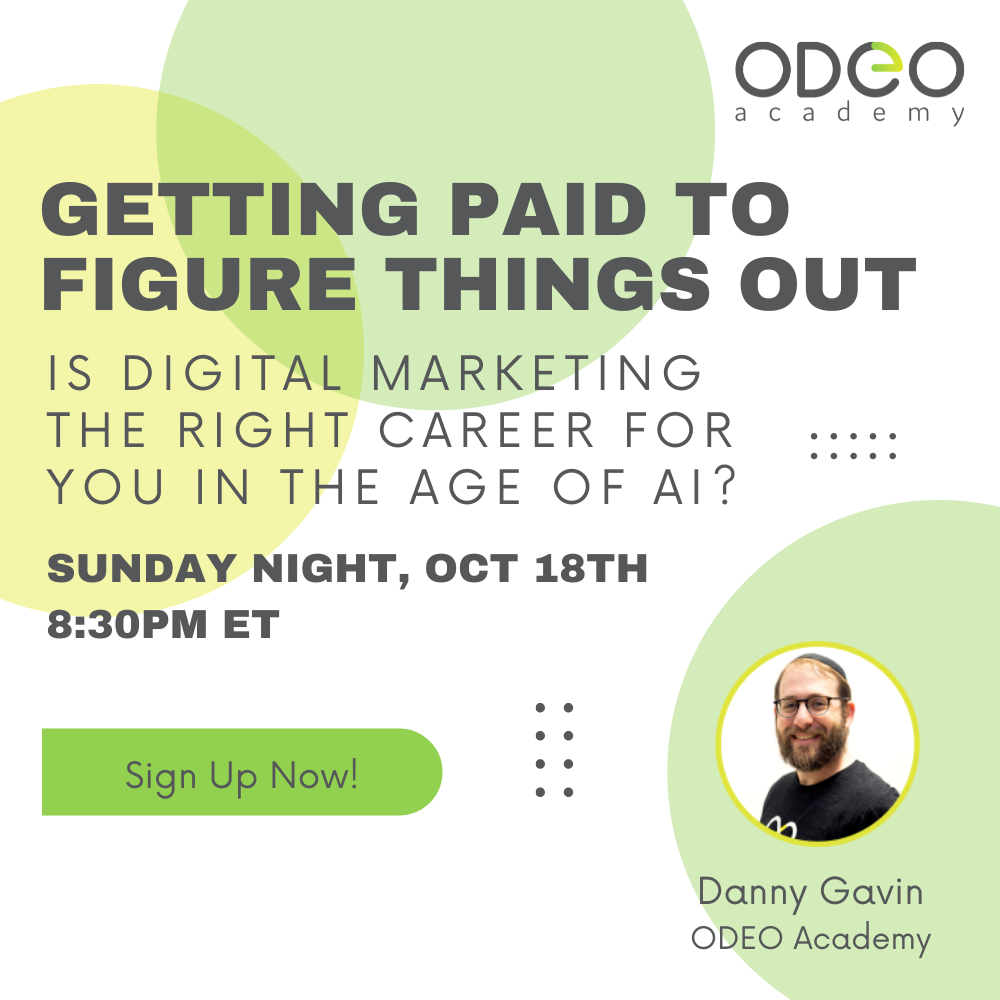
A good first step is ODEO’s free live webinar on October 18. It walks through what a career in digital marketing looks like and how the program works, and you’re welcome to bring your questions, or the person who’ll be asking them.
Want the full picture first? See everything the program includes.